Sunday, March 27, 2011

Soul Food: The Art of Storytelling

People want to feel personally connected to a brand and one of the most rewarding ways to build relationships with them is still through the art of storytelling. As much as I love social media, it is still just another vehicle for your message. It's the quality of your content that counts.

It may seem warm and gooey at times but telling the tale of those influencing or influenced by your brand humanizes you immensely. Storytelling is the soul food of public relations efforts when it comes to your target publics, brand and you the practitioner.

Telling these stories is an exceptional win-win-win situation because:

  1. It not only helps to strengthen the connection with your current audience, but it can also help create new, meaningful relationships you didn’t already have with potential audiences.

  2. Sometimes those narratives feature an individual (or more) that makes an incredible impact in the efforts of our brand who now gets to have her/his story immortalized.

  3. Getting to scribe those stories gives you, the author and practitioner, a deeper sense of personal accomplishment that most analytics can't “measure” up to. In fact, you'll see better analytics as a result of strong storytelling.

Every two months my organization publishes a national magazine known as Quill for which I write a membership profile column. With each story I write I have a chance to help our members and other journalists learn more about people like them who have invested themselves in SPJ and have made unique contributions to the profession.

In the latest member profile, I was able to highlight an incredible individual, Hank Klibanoff, whose efforts continue to shed great light on the struggles of the civil rights era. Upon reading the article, Hank wrote to me in an email saying “I caught up with the article you wrote about me for The Quill, and am impressed by it. You did a wonderful job, and you got it right. Thank you.”

As Charles Schulz might would have said, Happiness is a warm thank you letter. By the way, you should keep those letters and printed emails from the people who have told you how much your efforts mean to them. Put them in a scrapbook. On a rainy day, they’re worth so much more than a plaque on your office wall.

Another great way you can build relationships with your publics is by telling the story of how your brand relates to them on a cultural scale like PR colleague Melissa Bennett did. Last December I stumbled upon a guest post Melissa wrote for Peas for Prosperity titled “Peas on Earth - The Origin of the South's Famous Black-eyed Peas.” The post described the deep history behind the tradition of eating black-eyed peas on New Year’s Day in Southern U.S culture. Guess what? I grew up in the South and have eaten black-eyed peas for New Year's since before I can remember. This well written back story just gained a new audience member interested in Peas for Prosperity.

To really dive into the craft and learn how to be a better storyteller for your brand, I highly suggest reading Ishmael’s Corner by PR consultant Lou Hoffman. Ishmael’s Corner is a blog devoted to giving great analysis, additional methods and insights into the art of storytelling from a business perspective.

Here are my 10 favorite reads from the Ishmael archives:

  1. Revisiting the All-important Anecdote

  2. Communications Versus Behavior During a Crisis

  3. Visual Storytelling via the InfoGraphic

  4. Top Five Elements That Have Shaped Quest for Creativity

  5. 10 Ways Communicators Must Evolve

  6. The Quickest Way to a Dull Story: Jargon

  7. Blast Magazine’s Media Kit Tells A Story

  8. Every Story Benefits From A Hero (Or Two Or Three): Business Storytelling

  9. Hard to Beat the Classic Immigrant-Makes-Good Story

  10. Storytelling in a News Release: Are You Fit for a Phone?

What amazing stories have your brand told lately?

Friday, March 11, 2011

Early Adopters and the Social Web

Early adopters have held an important stake in cultural acceptance of new innovations throughout history. And with the extensive growth of social media over the course of the past few years, these influencers’ “phenomenal comic powers” have become paramount in the success of a brand’s marketing strategy.

What really made me think about this was the hilarious example this past Friday by comedian news anchor Stephen Colbert with his endorsement of the new iPad II on Twitter. His tweet garnered over 100 re-tweets in less than an hour. It doesn’t get more influencer relevant than that.


Since social scientist Everett Rogers’ 1962 study developed the four acceptance categories that early adopters belong to, they have continued to play a key strategic role in product marketing and brand development. The powerful influence of the early adopters often sways the early majority and combined, the two groups can account for half of a new product’s sales. The success or failure of a brand often relies on their influence.

The Anatomy of Early Adopters

So what does an early adopter look like? According to a 2010 report from Advertising Age called Shiny New Things: What Digital Adopters Want, How to Reach Them, and Why Every Marketer Should Pay Attention, a study by Forrester Research coupled early adopters “technographic” profiles with psychological theories and found that three key drivers compel them:
  1. Risk Taking - A desire for novelty that exceeds caution and reflects a “universal openness to new experiences, including new products. They are willing to take a chance on a product with little to no market history.” There is also a desire to be first.
  2. Information Gathering - “There is an informational burden that needs to be overcome for new products, and early adopters are more likely to seek out the information needed to inform their adoption decisions.” But they also “seek to mitigate risk through information.”
  3. Status Seeking - Early adopters take pride in showing off their purchases. Early adopters choose products that represent them to the world—their preferences as well as their social status.”

In another study by Nielsen and Mindset Media, early adopters of new technology scored high on certain personality traits in regard to purchasing habits:

  1. Leadership - 68% are more likely to have purchased three or more computers in the past two years.
  2. Dynamism - 58% are more likely to have purchased three or more flat-screen TVs in the past two years.
  3. Assertiveness - 62% are more likely to purchase a new cell phone when the latest and greatest model hits the streets.
  4. Modesty - 45% are more likely to upgrade when a new model is available.

Finding Success in Early Adopter Outreach

Influencers are unique individuals who require personal strategies of communication. According to iMediaConnections’ C.C. Chapman, there is no science to finding the right influencers because there are far too many factors in play for it to be that easy.

“I've used many services, companies, and other outlets to assist in compiling influencer lists,” Chapman said in a blog post. “But I have yet to find anything that works better then good, old fashion networking and research.”

As an influencer and early adopter, Chapman recently published a list of four ingredients for successful influencer outreach at iMediaConnections.

On the social web, researching and approaching these influencers isn’t easy. Mere friend/follower counts and profile views fall short of accurately measuring and identifying true influencers. Simon Dumenco with Ad Age Digital set out to further debunk that perception by analyzing the supposed top Twitter influencer rankings on several subjects provided by a marketing firm that specializes in this type of research. The results showed ineffective accounts with limited influence.

That is why it is important to perform intricate research into who a brand or product’s target audiences are and cultivate sincere relationships with them. Social media based influencer relations is critically different from traditional PR methods and requires varied tone, purpose, and understanding. When you apply that philosophy you’re sure to see a higher Return on Investment.

An innovative way to help generate early buzz from adopters and continue to nurture personal relationships is to conduct one-on-one briefings with them via Skype. This insightful idea from Ogilvy’s 360 Digital Influence team gives influencers an exclusive first look at the product even when a brand has a limited number of prototypes available.

Sunday, February 20, 2011

Innovating with Facebook's New Fan Pages

Facebook released new design and feature changes to its fan pages two weeks ago, Feb. 5, bringing them up to date with a layout that now provides improved engagement with fans, features photos and offers better analytics for page administrators. This new version comes after Facebook’s redesigned profile pages launched last December.

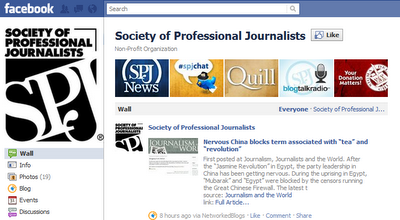
After I switched the Society of Professional Journalists fan page to the upgrades, it sparked the idea to use this latest version as an opportunity to have some fun while creating a new Facebook branding strategy for SPJ. A week later, we’ve now converted the photos displayed on our fan page as promotional space to showcase various programs provided by SPJ.


As you can see above, the first set of promotions feature SPJ’s additional communications vehicles so we can better help our members and followers stay connected with what SPJ is doing in the journalism profession. Once clicked on, the description for each image provides a brief overview of that topic and additional links to those resources. In the coming months these placements will cycle and alternate with other themed placements to help SPJ’s Facebook fans with awareness of other programs such as our professional development, ethics and FOI resources.

Of course there are some limitations to this new strategy that brands will encounter. Unlike some of the creative ideas that have been spawned by their profile page alter egos, fan pages’ photos are continuously randomized and do not maintain a specific order of placement. Given the 25 possible screen display outcomes, this specifically prevents any synchronized efforts to create one consistent, single promotion that spans across all five spaces.

Another constraint I tweeted about with Washington Post Live intern and Media Bistro 10,000 Words blogger Kevin Loker concerned what happens next when an image is clicked. Images that are larger in scale than the exact size displayed on a fan page’s main wall will create an off-centered image when viewed on the wall. However, not enlarging the image means that it will remain that smaller size once it is clicked on. Deciding how to proceed given both constraints largely depends on personal preference.

As Facebook makes further advances, these factors will hopefully be taken into account and these problems may dissolve themselves over time. Until then, we are not the only ones who aren’t letting that stop us from experimenting. Kevin tagged me in on another conversation where USA Today College also had some fun with the new upgrades this past Friday.


When using these types of promotions for fan pages it is important to do so ethically and legally. Be familiar with the Facebook Advertising Guidelines.

Want to know more about the process that went into creating SPJ’s new Facebook promotions? Read a more in-depth entry by following this link to the SPJ headquarters blog where you can learn about the behind the scenes perspectives that went into this project - the ideas, failed concept work and a sneak peek at our next series of promotions.

Saturday, February 5, 2011

Basic Principles: The Hitch Factor

Last night I decided to watch one of my favorite movies, Hitch. The 2005 comedy is about matchmaker Alex Hitchens’ (Will Smith) behind the scenes work to help hopeless romantic Albert Brennaman (Kevin James) win the heart of society heiress Allegra Cole. With an energetic storyline, fluid comedic timing and jazzy soundtrack, Hitch is one of the few movies I find worth watching on a yearly basis.

Fun Fact: The opening credits sequence displaying the title for the film inspired the banner for this blog.

But it was not until recently that I was able to appreciate the film for its positive, underlying inspiration for public relations and marketing professionals. So what gives a practitioner the Hitch factor?

Hitch’s own techniques focus on brand management for guys hoping to get the girl of their dreams. And no marketing strategy is successful without comprehensive research of your brand’s target audience.

For Hitch, his research involves understanding important social dating techniques to better connect those audiences and his clients. Depending on the target audience (Allegra in this instance) it is important that PR practitioners should do concentrated research to understand what key messages most interest an audience and will better connect them with a brand (Albert in this instance).

Of course, the fundamental cornerstone of Hitch’s strategy is client confidentiality and trust. Practitioners should always safeguard critical information about their clients and conduct their work in a discrete, professional manner.

“My business is 100 percent referral and thus far untraceable. And if there’s one thing I’ve learned when you orchestrate, coordinate and otherwise mess with fate, it’s best to fly under the radar.” - Hitch

Hitch understands that secrecy is an important part of public relations but he also knows that it should never override ethics and the public interest.

Strong ethical standards are always an important component to being a successful public relations practitioner. Hitch’s own moral compass is showcased often through his sense of compassion and understanding. Early on in the film, he asserts his standards and refuses to work with chauvinist Vance Munson as a client.
“Hit it and quit it is not my game.” -Hitch

Passionate PR professionals care about and protect their brands from misperception and falsehoods. Hitch does this while also emphasizing his ethical principles when he later clarifies his association with Albert to Allegra. My job is not to deceive Ms. Cole. It’s to create opportunities.” - Hitch

Promoting a brand also requires positive energy and confidence. Hitch does so with an air of savoir faire about him. He highlights this quality often through the use of constructive quotes.

“Basic principles: No matter what, no matter when, no matter who, any man has a chance to sweep any woman off her feet. He just needs the right broom.” - Hitch

“Like I always tell my clients - begin each day as if it were on purpose.” - Hitch

“Always remember, life is not the amount of breathes you take. It’s the moments that take your breath away.” - Hitch
.
“Never lie, steal, cheat, or drink. But if you must lie, lie in the arms of the one you love. If you must steal, steal away from bad company. If you must cheat, cheat death. And if you must drink, drink in the moments that take your breath away.” - Hitch

Did you happen to notice the recurring theme in the last two quotes? Catch phrases and slogans are an important part of marketing - even when branding your personal self. Do so eloquently and before you know it, you'll achieve the Hitch factor.
.
Of course, if Hitch isn't your Jerry McGuire, then maybe you and PR pro Mike Schaffer share the same role model. I hear the guy is “Legen - wait for - Dary! Legendary!”

Saturday, January 29, 2011

Building Strong Social Media Guidelines

It is no secret that the growing causes of most crisis PR moments in the past decade were a result of poor social media comprehension. Preventing these disasters proactively should be a major part of any integrated communication and reputation management strategy. That is why it is incredibly important for organizations and companies to develop and implement strong social media policies and guidelines to help safeguard their brand and employees.

It is also important to understand that having social media guidelines is not just critical in regard to reputation management and clarifying gray legal areas. There are many different considerations that should go into guidelines. To begin with, they should be a means of encouragement for employees to help promote and strengthen brands.

Right now I find myself tasked with developing more comprehensive social media guidelines for my own organization. The difference between the Society of Professional Journalists and most entities is that the non-profit organizational structure within SPJ means that the majority of our social media participants are volunteers rather than employees. Because of this, special care is being taken into consideration for writing the content of these guidelines. I'm making a point to seek as much advice as possible to create the best language to help our volunteers adapt to and implement these needed procedures.

When creating your own social media guidelines, it is best to research a wide selection of different examples to help you understand what best reflects your own organizational needs. Working on this project for the past few weeks has taught me a lot about different types of policies and I want to share some of the online resources that were a huge benefited for me throughout the process.
.
Social Media Governance Database - Includes more than 100 different social media policies for a wide spectrum of different companies, organizations and other entities.

How to Deal With Haters and Potty Mouths on Your Newsroom’s Facebook Page - From Journalistics, I loved this article not only for its insightful quality of content focused on Facebook but also because of its light-hearted nature.

10 Must-Haves for Your Social Media Policy - From Mashable, this handy list focuses on what it refers to as the most important aspect of writing guidelines, to better engage target audiences.

On a final note of consideration, a strong policy should make a point to reflect the transformative nature of social media. From Facebook to Twitter, who knows how the next form of communications vehicle will take shape. Even once titans such as Myspace can begin to fall over time as the way we use the Internet continuously evolves.
.
It is a changing new world online and a strong, durable set of guidelines are just the foundation blocks to helping your brand expand and maintain a positive reputation.

Saturday, January 8, 2011

Down the Road Less Traveled

A year past. A year ahead. Ambition will lead me...

It may come eight days after the fact but, Happy New Year! I know mine has certainly been exciting and already filled with new challenges.

For me, 2010 was quite a year. The remaining days of my college tenure were filled with many achievements including creating, developing and implementing a student government debate; leading my chapter of the Society of Professional Journalists and awards recognition for my creation of a public service PR campaign. I also came across a few failures along the way.

After graduating I found myself working in one of the best possible entry-level jobs I could ask for with the Society of Professional Journalists. Stationed at its national headquarters in Indianapolis, the past few months have been an incredible benefit in developing my PR, marketing and media relations experience. Even more, it's given me the opportunity to be an important part of a non-profit organization that is devoted to improving and protecting journalism and the First Amendment.

I was lucky to once sit on the front row of a presentation featuring NBC Nightly News Anchor Tom Brokaw when he said "You cannot let this forum go away. If you lose journalism, you'll lose the essence of the republic." Even in the turmoil journalism has faced over the past decade, I still have hope for its changing future and the Society is a part of that.

My blog has also continued to improve over the past few months. And for all of those who tweeted, shared and commented on "35 Big Twitter Hashtags for PR Pros," it is both a humbling and thankful experience to know it has been such a useful resource helping many students and practitioners. Thank you for sharing with me.

So here I am at a New Year - 2011. And no yearly beginning is complete without resolutions to hold one's self accountable by!

My Resolutions:
  1. I will continue to adhere to strong ethical standards in the practice of public relations while working to expand my knowledge and experience beyond my current capabilities.

    (Well that first one was easy. Let's just call it my "mission statement" resolution. Now how about some "meat and potatoes" resolutions that are a little more"objective" based.)

  2. I will fully participate in a minimum of 10 PR related Twitter chats in this list of 13 by Petya N. Georgieva by the end of December 2011.

  3. I will increase both the quality and yearly quantity of the entries here on my blog to better enhance my professional experiences and service to other PR professionals with a minimum of 20 posts by the end of December 2011.

  4. I will officially pursue an APR accreditation while improving my fundamental knowledge of communications theory and its application in the field to better serve clients, the public and the PR profession by the end of September 2011.

I have to admit that the last resolution was honestly the scariest one to write out loud. The APR is an important asset that is the nation's only post-graduate certification program. Studying for this accreditation is an intense and time consuming process that takes patience. Nevertheless, the benefits will help in my career enhancement and promote lifelong learning.

It's important to believe in goals but saying them out loud is what breathes life into them and makes them real. No success is ever achieved without ambition and faith in yourself. I certainly would not have had such an incredible year in 2010 if not for that philosophy.

Where will your ambitions take you this year?

Saturday, November 20, 2010

35 Big Twitter Hashtags for PR Pros

Twitter is an exciting place for new and seasoned PR professionals to come together and share ideas and opportunities in the profession. The key to optimizing your Twitter experience is to take advantage of its hashtag resource which links related topics together with a simple # at the beginning of a word, acronym or phrase.

Over the past few days, I've researched some of the top PR related hashtags and their benefits. For the new Tweeters out there, or those still thinking about taking the plunge, I hope you'll take advantage of these 35 big Twitter hashtags for PR pros!

Most Common:
#PR – Obviously one of the two most encompassing tags, it's the most optimal for 140 character tweets. Great for mixed industry related posts.
#publicrelations – This tag may be the same concept as #PR, but the tweet results are hardly the same. Great for mixed industry related posts.

Practice & Expertise Focused:
#branding – Lessons for #corporate or #smallbiz related work.
#personalbranding – Perfect for learning to promote your self.
#mediarelations – Helps develop stronger relations with news media
#reputationmanagement – Tips/case studies for building and maintaining reputations.
#marketing – Industry news and strategies.
#crisismanagement – Trends, strategies and case examples of good/bad crisis work.
#CrisisPR – Like #PR/publicrelations, this tag is just as effective while diverse.
#publicity – Often sporadic in content value when searched, the worth while tweets make up the difference.
#advertising – Great techniques and trends.

Social Media Focused:
#socialmedia – Great for most trends and strategies for social media.
#SM – A second social media tag.
#digitalmarketing – Great for emphasis trends, news and some job opportunities.
#SEO – Search Engine Optimization related content.
#SMO – Social Media Optimization related content.
#smcedu – Weekly chat (Mondays, 9:30 am PST) devoted to ensuring that college grads are media literate and capable of applying emerging lessons from social media in organizations.

PR Jobs:
#prjobs – The definite way to find career opportunities and advice.
#prjob – Despite the one character difference, the opportunities and advice often vary.
#EntryPR – A specifically important tag for finding entry level jobs that are available and additional advice.
#happoHelp A PR Pro Out constantly provides job seeking advice, internships, and job opportunities with a focus on networking. The next organized chat will be on Wednesday, Dec. 8 from 8-9 pm CT.

Professional Development:
#PRadvice – A pretty wide spectrum of content with direct advice tweets and URL links.
#prtips – A pretty wide spectrum of content with direct advice tweets and URL links.
#pr20chat – Weekly chat (Tuesdays, 8 pm EST) discussing public relations social media related issues for the future.
#u30pro – Weekly chat (Thursdays, 8 pm EST) focusing on issues surrounding PR professionals under 30.
#solopr – Weekly chat (Wednesdays, 1 pm EST) designed for independent PR professionals and those interested in learning more about this career emphasis.
#measurepr – Bi-weekly chat (Tuesdays since 2/2/10, 12-1 pm ET) focusing on all things measurement in public relations and social media measurement too.
#brandChat – Weekly chat (Wednesdays, 11 a.m. EST) with focused topics about branding and marketing strategies.

PR Students:
#PRstudents – Mostly for building student's credentials and a frequent source for internships.
#prstudchat – Monthly chat (different days and times) focused on students and professionals coming together to share thoughts.
#PRintern – Learn about current student internships that are available.
#prssa – The Public Relations Student Society of America.

PR Organizations:
#prsa – The Public Relations Society of America.

Journalism Related:
#journalism – Great for most journalism related posts.
#journchat – Weekly chat (Mondays, 7 pm CT) between journalists, bloggers and PR pros.

Thursday, November 18, 2010

2nd Street Baking Co. Against the Mayhem

Two weeks ago a justice was served in the name of copyright protection as the Internet made clear its stance on infringement. This came after blogger Monica Gaudio posted a scathing e-mail from New England based Cooks Source editor Judith Griggs claiming the blogger's unpaid article in the magazine was "public domain."

But there are two sides to every coin. The Internet tirade quickly engulfed the unknowing advertisers of Cooks Source into its rage. To quote the website, How Publishing Really Works, "You can't release the hounds and then expect them to behave like lap-dogs."

The businesses that were listed as the magazine's advertisers were pummelled throughout the next few days with angry calls, emails and threats to boycott. But one small town bakery somehow managed to succeed where even some large, corporate businesses have often failed in this situation; with an effective and timely crisis communications strategy.

2nd Street Baking Co. is a custom style bakery in the village of Turners Falls, MA. The business has been open now for three years under owners Christa Snyder and Laura Puchalski. Laura first learned about the scandal at approximately 1:30 to 2pm that Thursday, just as the story was breaking online. The baking company's email account began receiving dozens of emails from people all over the country as well as Australia and Canada.

According to Laura, most of the angry e-mailers had copied a form letter that was posted on Facebook to notify the Cooks Source advertisers that they were "supporting plagiarism" by advertising with the publication. The message threatened to boycott their company and its products unless 2nd Street chose to pull their advertisements. Other emails were more brazen and offensive with lines like "how dare you support Cooks Source."

Laura immediately logged on to Facebook to find out more. Seeing the numerous posts on the Cooks Source fan page and researching about the story, she became deeply concerned about the quality of the publication 2nd Street Baking Co. was supporting.

"Not only do we disagree with the way Monica's work was used without her permission, I worried that the association with Cooks Source would negatively impact our business," Laura told me in our email correspondence.

What does it take for a small home-owned business to fight against the mayhem? Engage your audience on their playing field. Within minutes of learning about the situation, Laura began to post a public statement on Facebook that they were pulling their ads.
"As an advertiser, we are disappointed in Cook's Source as we are pulling our ads from this publication. Many of us (as is the case with our business) paid several months in advance for advertising and are unlikely to get any compensation back. We ask that you please stop emailing our business, we agree that the publication made a grave error, but the blame should be placed with them. Please do not make small businesses like mine pay for their error in judgment. "
- Laura Puchalski
(2nd Street Baking Co.)


Laura then continued to post the statement about every 20 to 30 minutes for the first few hours on the Cooks Source Facebook page, with an additional posting on the bakery's Facebook page as well. She also began posting on Cooks Source's Facebook "Discussions" page where new threads would start-up like "Cooks Source Advertisers List."

"As I posted that we had pulled our ads, I would get dozens of responses immediately and the emails would slow down," Laura said. "Then as the statement got pushed further down the page and lost in the sea of other angry posts, the emails would start up again and I would have to post again."

In Laura's research, she discovered that Neil Gaiman had posted something about Cooks Source. She then used the bakery's Twitter account to respond to him in hopes that his 1.5 million followers would pass along the message that they had distanced ourselves from the publication.

"He did help us out in that respect, and also made a donation to the Food Bank of Western MA, which we very much appreciate," Laura said. "We were getting a huge response from people wanting to send us money to compensate our lost advertising dollars, or requests to order products from us in support of us pulling our ads.

Because 2nd Street could not ship most of their products and they did not feel it was morally right on their part to accept money from people, the owner's instead asked for support by donations to the local food bank.

Laura received an email response that evening from Griggs, confirming that the bakery's ads would be removed.

"I have tremendous respect for the power of the Internet!" Laura said. "It can be an extremely useful tool for promoting your business and communicating with your current and potential customers. Unfortunately it can also ruin you, as evidenced by the situation with Cooks Source."

2nd Street Bakery's story is a positive light where others have quickly fallen victim to this kind of chaos. So what public relations strategies can small businesses take away from the experience of 2nd Street Baking Co.?

Research your dilemma:
  • Make sure you know ALL the facts
  • Appoint a spokesperson who will serve as the point of contact between your business and the media
  • Identify key audiences - your local consumers, employees, the media and the Internet
  • Develop a communications strategy - including your plan of tactics
Take action in a crisis:
  • Act quickly to resolve the dilemma
  • Tell the truth
  • Don't editorialize
  • Be accessible to the press and other publics
  • Show compassion
  • Update your message as frequently as you can
I also asked Laura to weigh in on what she learned from this experience. In her own words:
  • First and foremost, remaining calm is always best. It is never a good idea to communicate from a place of anger, confusion, or fear. Keeping calm allows you to really think about what is happening around you and decide what the best approach to take for your business really is.
  • Acting fast to minimize the impact to your business is also helpful, and respecting your customers (and potential customers) and their feelings is important.
  • Knowing that the Internet is a powerful force of positive and negative publicity for your business is also important. It is the fastest way to reach the multitudes and get your messages across. In this instance, it is where this was all taking place so it was also the logical place to communicate our position.
  • And always be as professional as possible!
I also discussed an additional tactic with Christa and Laura that they agreed small businesses should consider.
  • Use your email to your advantage in this situation. Most email providers include an automated reply message that users can program in their absence. For a small business under the gun from a continuous number of emails, utilizing this means of response will save a lot of time and emotion while helping to quickly spread your message. It will also create less of a disruption for your limited resources.

As a continuing student of the public relations craft, my sincerest respect goes out to Laura and the people of 2nd Street Baking Co. for their inspiring work. It's not often people talk about the crisis communications scenarios that go right but theirs is certainly one worth telling.

Sunday, November 7, 2010

The Curious Case of Cooks Source and Poor Reputation Management

The Internet set to flames this past Thursday when New England based Cooks Source Magazine became the center of a copyright infringement and plagiarism controversy with blogger, Monica Gaudio. It's become an epic tale of rightful justice and poor reputation management under crisis.

After Gaudio discovered that the magazine had published a piece she had written about apple pie without her permission, she contacted the publication requesting an apology as well as a $130 (10 cents per word for her 1300 word article) donation to the Columbia School of Journalism.

Enter the now infamous editor Judith Griggs and her response to Gaudio:


But honestly Monica, the web is considered "public domain" and you should be happy we just didn't "lift" your whole article and put someone else's name on it! It happens a lot, clearly more than you are aware of, especially on college campuses, and the workplace. If you took offence and are unhappy, I am sorry, but you as a professional should know that the article we used written by you was in very bad need of editing, and is much better now than was originally. Now it will work well for your portfolio. For that reason, I have a bit of a difficult time with your requests for monetary gain, albeit for such a fine (and very wealthy!) institution. We put some time into rewrites, you should compensate me! I never charge young writers for advice or rewriting poorly written pieces, and have many who write for me... ALWAYS for free!"

Following the Nov. 4 Internet explosion upon the Facebook page of Cooks Source Magazine, Griggs allegedly wrote:

"Hi Folks!
Well, here I am with egg on my face! I did apologise to Monica via email, but aparently it wasnt enough for her. To all of you, thank you for your interest in Cooks Source and Again, to Monica, I am sorry -- my bad!You did find a way to get your "pound of flesh..." we used to have 110 "friends," we now have 1,870... wow!
Best to all, Judith"

And in what continues to reflect the lame duck communications of Cooks Source Magazine, the publication has released a statement on their website. The 862 word apology mostly focuses on the Magazine's own personal "victimization." Due to its length, I've highlighted two select portions of the statement relevant to this entry. You can read the full apology here.

"We have cancelled our Facebook page on Thursday, November 4th, 2010 at 6:00PM. It has since been since been hacked by unknown parties and now someone else unknown to us has control of it. Their inclusion of Cooks Source issues and photos is used without our knowledge or consent. Please know that none of the statements made by either Cooks Source or Judith Griggs were made by either our staff or her...

...Last month an article, “American as Apple Pie -- Isn’t,” was placed in error in Cooks Source, without the approval of the writer, Monica Gaudio. We sincerely wish to apologize to her for this error, it was an oversight of a small, overworked staff."

And thus, a simple analysis while highlighting a few very simple lessons to take away from this mishap. The first applies to anyone in the communications field:

Rule #1 (And the Golden Rule I might add): Don't plagiarize and know your copyright laws. As a business entity, constantly work to ensure high standards of ethical and legal business practices among all employees. Place additional emphasis on teaching proper decision making scenarios to apply their legal knowledge in. Apparently Cooks Source Magazine couldn't seem to grasp the simple logic of copyright law and it cost them.

Next, is the issue of social engagement with your publics.

Rule #2: Have a set policy for all employees when handling internal and external communications. Never assume emails are private. Once the information you publish is "sent," it's out there and anything can happen with that content. I think the Steve Jobs v. Chelsea Kate Isaacs incident gives some additional background into that principle.

Rule #3 (Also making Rule #2 obsolete): Be professional at all times when conducting all communications with your publics. This is where Griggs truly fails. Rather than acknowledging her mistake and diffusing the situation, she chooses to take a highly demeaning standpoint towards Monica. In her editorializing, Griggs also reveals her huge lack of understanding copyright infringement. The two factors, arrogance and ignorance, would only add fuel to the fire. As a rule of thumb, avoid writing aggressive, defensive responses.

Now what do you do when a reputation management crisis hits?

Rule # 4: Silence is not golden. Under crisis, engage your audience and publics. An important strategy to this rule would be to pre-develop protocol and train key communicators on how to actively and positively combat negative engagement online. Once the Cooks Source blaze took off, nothing "official" would be heard from Cooks Source Magazine for six days. Six days is a long time in the realm of the Internet. Aside from the Facebook status update from Griggs, the magazine would not respond to any media inquiry, including my own on behalf of the Society of Professional Journalists.

In a recent article on integrated marketing communications, I highlighted a very dangerous aspect that some "brands without efficient response to this form of dialog within the past year have in turn suffered drastically negative exposure at the hands of consumer social media." The same holds true for Cooks Source Magazine. Not responding only lead to further suspicion across the media and Internet.

Timeliness is everything.

Much like the Tiger Woods affair scandal, Cooks Source Magazine's withdrawal from public communication only lead to further investigations like that of journalist/blogger Ed Champion, revealing that the publication had repeatedly used copyrighted material from other outlets and personalities such as NPR, Paula Dean and the Food Network.

Rule # 5: Don't Editorialize. Be short and factual. I already mentioned this in Rule #2 but it honestly needs it's own rule. If your company or organization finds itself in an a difficult situation, it's best to know when to disengage from editorializing and instead focus on straight-forward statements.

Cooks Source not only takes on a role of personal victimization, but it also tries to assume an authoritative stance in the "official" statement. Cooks Source takes to condemning the "disreputable" internet for attacking them while "protecting" the advertisers of Cooks Source, the small businesses and farms in area that rely on Cooks Source and even, Gaudio? (From the Cooks Source Statement: The misuse of Facebook discussed above also applies to Ms. Gaudio: she did what she felt was the right thing, and doesn’t deserve this kind of treatment, either.)

Unless something is missing here, no mass congregation of the Internet has taken to attacking Gaudio. Of course, taking Cooks Source's above rationale into perspective, the running Facebook meme "But honestly Monica, (insert something ridiculous about Cooks Source)" might be misunderstood as an attack on the blogger rather than the obvious attack on Judith Griggs.

Further editorializing while inadvertently trying to draw attention elsewhere, the statement goes on to back-hand Facebook when referencing their corporate number.

"Interestingly, this phone number and any other contact info is not listed on the Facebook site, and has taken four people a number of days to track down."
(Note: It took one me less than two minutes to find the same contact numbers via Google search...)

Prior to that comment, the publication identifies their Facebook page being "hacked" and "someone else unknown to us has control of it." Aside from the Griggs Facebook quote above (predating the 6 p.m. cancellation on that date), no such hacking has truly taken place. This further indicates that Cooks Source is either ignorant of how the Internet, Facebook and social media works, or they could just be lying.

If the magazine had merely published strait forward facts, none of these assumptions would be in question. This brings us to the last rule.

Rule #6: Just tell the truth. By the time readers finally arrive at the "apology" segment of the statement, Cooks Source disclaims that the article by Monica was "placed in error" due to the "oversight of a small, overworked staff." Not only is this editorializing, it's makes excuses and takes a lack of responsibility. This case is hardly an "oversight" if reflecting the number of additional infringement cases that have surfaced as a result.

The Magazine's statement that their Facebook account was "hacked" with the inclusion of Cooks Source issues and photos without their knowledge or consent is also missing a few key points in their logic. A closer look at any one of the aforementioned issues and photos will reveal Facebook publication dates going back months prior to any alleged hacking.

The curious case of Cooks Source Magazine is definitely a paradigm shift in a positive direction for copyright protection on the "world wild web" and an encompassing example of what not to do when it comes to crisis communications.

Wednesday, September 8, 2010

My Love of Books

Last week I suddenly realized that it has been a while since I have written anything of personal note as an entry. Keeping with my philosophy that public relations is a "personal" way of life, I would like to share one of the great facets into my very "interesting" brain.

I love books! I always have!

When I was in the fifth grade, my school participated in the Accelerated Reader program. Even at that age, reading intrigued me and inspired my imagination. Unfortunately the teachers then really didn't try to gage what each individual student's true reading potential was and decided we all should start at the fifth grade level.

By sheer fate, I didn't realize this proclamation and instead picked up an 8.5 grade reading level book, "The Voyages of Dr. Doolittle." My teacher was shocked when she discovered what book I had picked up, but she let me continue as I was already half-way through reading it at the time. She was even more surprised when I scored 95% on the book's exam. She readily adjusted my reading level.

At the end of sixth-grade I was ranked second in my class under the Accelerated Reader program, behind an old friend of mine, Katie Moss, who is now pursuing a master's in English Lit. Third in the rankings was Zack Ray, a football player in high school who most of my classmates don't realize is an incredibly intelligent guy. Who knows why I remember this statistic, but I do.

Random Fact: My parents once owned a bookstore in Brookhaven, Miss. called Mullen & Scott Booksellers.

I have also slowly collected my own personal library over the past few years. It is comprised of leather bound, hard back and autographed editions of classics and other books of my fancy. Most of them I've read. Others, are what I would like to jokingly call a "retirement investment."

As a living list to be periodically updated, I would like to share what I have collected so far...


The Personal Library of Andrew M. Scott

Daniel Defoe: Five Novels
Jules Verne: Seven Novels
H.G. Wells: Seven Novels
Herman Melville: Seven Novels
The Chronicles of Narnia (complete, one book)
The Looking Glass Wars, Seeing Redd and Arch Enemy
Charles Dickens: Four Complete Novels
Wicked and Son of a Witch (one book)
The Complete Works of Lewis Carroll
The Complete Tales and Poems of Edgar Allan Poe
The Complete Works of William Shakespeare
Gone with the Wind
To Kill a Mockingbird (40th Anniversary)
Lord of the Flies (50th Anniversary)
The Divine Comedy
Bulfinch's Mythology
The Iliad and the Odyssey
Gray's Anatomy
The Complete Sherlock Holmes
The Ultimate Hitchhiker's Guide
The Art of War
The Art of the Kama Sutra
Teo Te Ching The Art of Harmony
Relativity - Einstein
Meditations - Aurelius
The Race Beat ~
Schulz and Peanuts (Biography)
The Wine Guide
Thomas Jefferson on Wine - John Hailman ~
Planet of the Apes
Arabian Knights
Jack London: Three Novels
Bikeman - Thomas Flynn ~
Mark Twain: Five Novels
Treasure Island
Carl Sandburg: Selected Poems
Uncle Tom's Cabin
Dr. Zhivago
Citizen Hearst
The Lord of the Rings (one book, 50th Anniversary)
The Hobbit
Plato: The Republic and other works
The Audacity of Hope
The Assassination of Abraham Lincoln
The Poems of Abraham Lincoln

The Reagan Diaries
The Last of the Mohicans
Ben-Hur
The Max Lucado Christmas Collection
Stephen Colbert - I Am America And So Can You
The Complete Frank Miller Batman
One Nation - America Remembers September 11, 2001
New York Days - Willie Morris ~
Richard Wright: Daemonic Genius - Margaret Walker ~
Start Something that Matters – Blake Mycoskie ~
Steve Jobs – Walter Isaacson ~
Onward – Howard Schultz
Don Quixote
The Picture of Dorian Gray
Oscar Wilde: Short Stories
Jane Austen: Seven Novels
Earnest Hemmingway: Four Novels
Crime and Punishment
The Scarlet Letter
The Three Musketeers
The Count of Monte Cristo
The Martian Chronicles
Hans Christian Andersen
Grimm’s Complete Fairy Tales
The Giant Book of Poetry
The Vampire Chronicles
Anna Karenina
The Star Wars Trilogy

Key:
BOLD (Leather bound) ~ (Signed by Author)
Last updated: Sept. 22, 2012

And I still have a couple of other books that are currently on my mind - Frankenstein, Dracula, H.P. Lovecraft Complete Novels.

Anyway, thanks for reading and I hope you found this random bit of information interesting in some way as a personal insight into who I am. If anything, "you stay classy!"