Showing posts with label Facebook. Show all posts

Sunday, March 30, 2014

Do the Creep: Facebook’s Pages to Watch

They’re watching you!

Last July, Facebook introduced page administrators to the Pages to Watch module, allowing them to choose up to five pages they did not manage and track their likes and other analytics. 

With this year’s Facebook updates, the Pages to Watch tool has now been added into the social network’s Page Insights, rather than being broken out as a separate module. The upgrades come with the ability to add more pages to the list as well as an analytical look at the number of posts and engagement those pages have received.

The tool comes with a few pros (instant analysis) and cons (hyper chronic competitive stress). Many page owners are simply livid that Facebook is openly providing “inside information about your marketing program so (the competition) can more easily monitor/monkey/copy your marketing strategy without having to go out of their way."

I can’t blame them for thinking that. It’s essentially the real-time social media version of The Lonely Island’s doing "The Creep.” (Side bar – These guys do some of the best digital shorts. I’ve never been disappointed.) But there is a flip side…

If you’re competitive in nature, Pages to Watch provides a “challenge accepted” state of mind. Savvy marketing and PR pros should expect the inevitability (don’t be a laggard) and flip this resource to work in their favor and use it as a means to think more critically about their content and engagement strategies. 

I was pretty excited because last Friday I got THE notification.


In their defense (whichever fan page it is), the odds are pretty strong that we’re creeping on them, too. I immediately built my own list when the module first came out eight months ago.

To paraphrase Nicki Minaj, “Get your Facebook strategy flex’n and your analytics T-Rex’n, and creep!”

Sunday, February 20, 2011

Innovating with Facebook's New Fan Pages

Facebook released new design and feature changes to its fan pages two weeks ago, Feb. 5, bringing them up to date with a layout that now provides improved engagement with fans, features photos and offers better analytics for page administrators. This new version comes after Facebook’s redesigned profile pages launched last December.

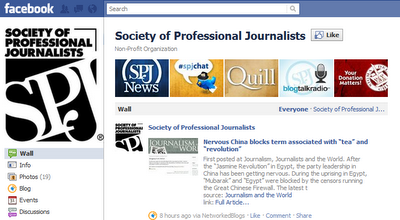
After I switched the Society of Professional Journalists fan page to the upgrades, it sparked the idea to use this latest version as an opportunity to have some fun while creating a new Facebook branding strategy for SPJ. A week later, we’ve now converted the photos displayed on our fan page as promotional space to showcase various programs provided by SPJ.


As you can see above, the first set of promotions feature SPJ’s additional communications vehicles so we can better help our members and followers stay connected with what SPJ is doing in the journalism profession. Once clicked on, the description for each image provides a brief overview of that topic and additional links to those resources. In the coming months these placements will cycle and alternate with other themed placements to help SPJ’s Facebook fans with awareness of other programs such as our professional development, ethics and FOI resources.

Of course there are some limitations to this new strategy that brands will encounter. Unlike some of the creative ideas that have been spawned by their profile page alter egos, fan pages’ photos are continuously randomized and do not maintain a specific order of placement. Given the 25 possible screen display outcomes, this specifically prevents any synchronized efforts to create one consistent, single promotion that spans across all five spaces.

Another constraint I tweeted about with Washington Post Live intern and Media Bistro 10,000 Words blogger Kevin Loker concerned what happens next when an image is clicked. Images that are larger in scale than the exact size displayed on a fan page’s main wall will create an off-centered image when viewed on the wall. However, not enlarging the image means that it will remain that smaller size once it is clicked on. Deciding how to proceed given both constraints largely depends on personal preference.

As Facebook makes further advances, these factors will hopefully be taken into account and these problems may dissolve themselves over time. Until then, we are not the only ones who aren’t letting that stop us from experimenting. Kevin tagged me in on another conversation where USA Today College also had some fun with the new upgrades this past Friday.


When using these types of promotions for fan pages it is important to do so ethically and legally. Be familiar with the Facebook Advertising Guidelines.

Want to know more about the process that went into creating SPJ’s new Facebook promotions? Read a more in-depth entry by following this link to the SPJ headquarters blog where you can learn about the behind the scenes perspectives that went into this project - the ideas, failed concept work and a sneak peek at our next series of promotions.

Saturday, January 29, 2011

Building Strong Social Media Guidelines

It is no secret that the growing causes of most crisis PR moments in the past decade were a result of poor social media comprehension. Preventing these disasters proactively should be a major part of any integrated communication and reputation management strategy. That is why it is incredibly important for organizations and companies to develop and implement strong social media policies and guidelines to help safeguard their brand and employees.

It is also important to understand that having social media guidelines is not just critical in regard to reputation management and clarifying gray legal areas. There are many different considerations that should go into guidelines. To begin with, they should be a means of encouragement for employees to help promote and strengthen brands.

Right now I find myself tasked with developing more comprehensive social media guidelines for my own organization. The difference between the Society of Professional Journalists and most entities is that the non-profit organizational structure within SPJ means that the majority of our social media participants are volunteers rather than employees. Because of this, special care is being taken into consideration for writing the content of these guidelines. I'm making a point to seek as much advice as possible to create the best language to help our volunteers adapt to and implement these needed procedures.

When creating your own social media guidelines, it is best to research a wide selection of different examples to help you understand what best reflects your own organizational needs. Working on this project for the past few weeks has taught me a lot about different types of policies and I want to share some of the online resources that were a huge benefited for me throughout the process.
.
Social Media Governance Database - Includes more than 100 different social media policies for a wide spectrum of different companies, organizations and other entities.

How to Deal With Haters and Potty Mouths on Your Newsroom’s Facebook Page - From Journalistics, I loved this article not only for its insightful quality of content focused on Facebook but also because of its light-hearted nature.

10 Must-Haves for Your Social Media Policy - From Mashable, this handy list focuses on what it refers to as the most important aspect of writing guidelines, to better engage target audiences.

On a final note of consideration, a strong policy should make a point to reflect the transformative nature of social media. From Facebook to Twitter, who knows how the next form of communications vehicle will take shape. Even once titans such as Myspace can begin to fall over time as the way we use the Internet continuously evolves.
.
It is a changing new world online and a strong, durable set of guidelines are just the foundation blocks to helping your brand expand and maintain a positive reputation.